Price per piece: when it helps, when it misleads
Price per piece divides what a LEGO® set costs by how many parts it has. It's a fair first filter between similar sets, and I wouldn't trust it past that.
This is not financial advice. We report prices and official dates. We don't forecast what a set will be worth.
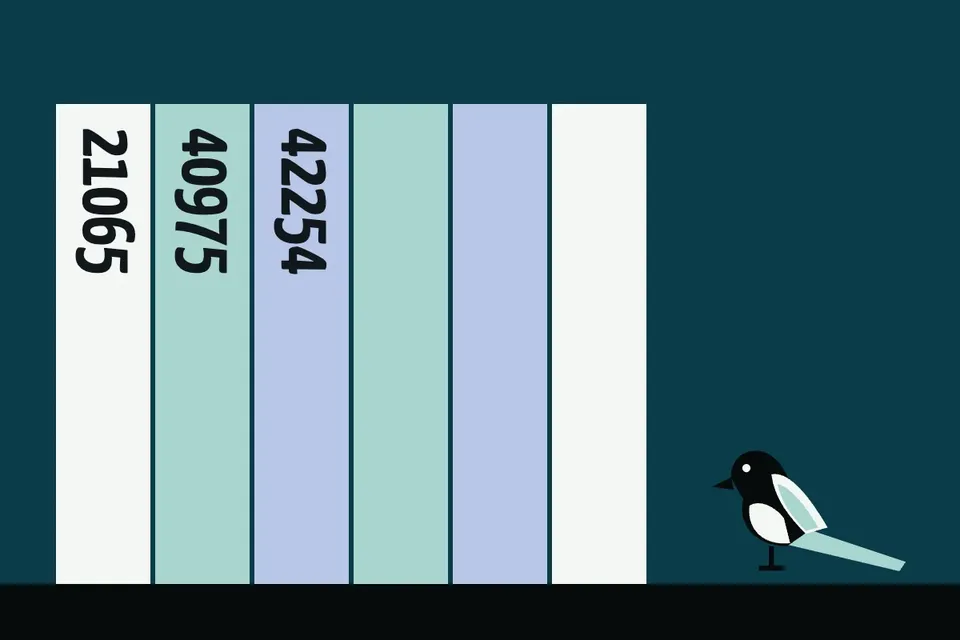
Take the price. Divide it by the number of pieces. That's the whole calculation, and every set page and the tracker do it for your market using the LEGO.com figure and the piece count LEGO lists.
21065 Sagrada Família shows how it works. It has 12,060 pieces, and in your market it reads £649.99$799.99€749.99€749.99€749.99€749.99€749.99, which comes to 5.4p6.6¢6.2c6.2c6.2c6.2c6.2c a piece.
Each market has its own number in its own currency. Don't set a figure in pounds beside one in dollars and call one of them the better deal. Compare sets inside your market, and leave the differences between markets as a separate question.
Where it helps
It's useful when two sets are alike in kind and you're stuck. Two large display models, both for adults, both meant for a shelf: a big gap per piece tells you something about how much building you're getting.
Sagrada Família and Executor 75457 make the point. Both cost the same in each of the seven markets we read, checked 3 Nov 2026. Sagrada Família has 12,060 pieces and Executor 6,130 pieces, nearly twice as many. If building time is what you're paying for, that's a real difference. You may not be paying for that, of course.
It's also quick. You can scan a column of per-piece figures and spot what deserves a second look.
Where it misleads
Similar counts, different objects
Look at 42254 Solar System Planets in Orbit beside 40975 Mini Hogwarts Castle. Solar System has 572 pieces and Mini Hogwarts has 700 pieces. Solar System reads £89.99$99.99€99.99€99.99€99.99€99.99€99.99 and Mini Hogwarts £34.99$39.99€39.99€39.99€39.99€39.99€39.99.
Per piece, that's 15.7p17.5¢17.5c17.5c17.5c17.5c17.5c against 5.0p5.7¢5.7c5.7c5.7c5.7c5.7c, about three times as much in all seven markets. Does that make Solar System a poor buy? Not by itself. They're different objects. One is a Technic model of planets in orbit and the other is a small castle, and the age marks are 10+ and 10+. All the sum tells you is that one has more parts for less money. The lowest and highest figures we track show how far the spread goes.
A piece is not a unit of anything
A tiny plate counts as one. So does a large structural part. Our data gives a total and nothing about the mix, which means a high count of small parts and a lower count of big ones can end up the same size on the shelf.
That's why Mini Hogwarts Castle, with the lowest price per piece of the 80 sets we track in all seven markets, isn't automatically the most model for your money. We have no dimensions for it in our data. For Sagrada Família we do: LEGO gives over 62 cm high, 47 cm wide and 39 cm deep. That tells me more about whether a set suits my shelf than any per-piece figure.
It ignores what you actually wanted
The number can't see the subject. LEGO says the Sagrada Família build follows the basilica's actual construction sequence, starting from the Apse and Crypt, and has a stained-glass window effect. Whether that's worth paying for is a matter of taste. A figure with two decimal places won't settle it.
The same goes for a character or a film you love. I'd pay more per piece for a subject I care about, and I'd expect you to as well.
How I'd use it
Use it third. First ask whether you want the thing. Then ask whether it fits your budget and your space. If two sets survive that, check price per piece, and treat a big gap as a reason to look closer at what's in each box.
One more catch. A set page only shows a figure when we have a verified price and a confirmed piece count for your market. Where we don't, you'll see "no figure", and that means we don't know.
If you want to see the measure applied to recent releases, autumn 2026 sets by price per piece ranks six of them.